Article updated on 6 September 2026.
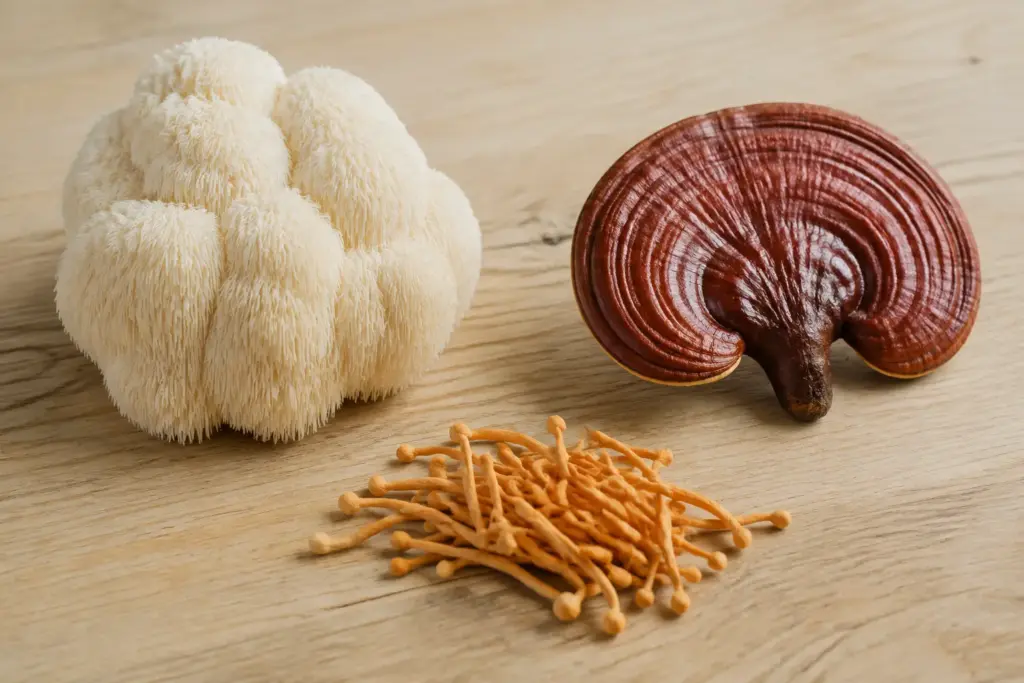
So-called ‘functional’ mushrooms are attracting a great deal of interest, but they do not constitute a family of interchangeable supplements. Lion’s Mane, reishi and cordyceps refer to different species, preparations and areas of research. Their presence in a coffee or a capsule does not guarantee any effect on concentration, stress or stamina.
Tradition, mechanism and human benefit: three distinct levels
Traditional use may inspire research. An effect observed in cells or in animals may support a hypothesis. To determine whether a supplement actually helps an adult in their daily life, well-conducted human trials are then required, using a standardised formulation and yielding relevant results.
| Mushroom | Common claim | What the cited data reveal |
|---|---|---|
| Lion’s Mane / Hericium erinaceus | Concentration, memory, mood | A few small trials suggest effects on certain tests; there is no guarantee of an overall improvement in all adults. |
| Reishi / Ganoderma | Stress, fatigue, ‘immunity’ | Outdated or narrowly focused studies are not sufficient to validate all the claims made about current products. |
| Cordyceps | Endurance and recovery | Preliminary findings, heterogeneous study designs and populations; practical relevance still uncertain. |
Lion’s Mane: a positive result on a test does not indicate a change in the brain
A pilot trial conducted in 2023 involved 41 adults aged between 18 and 45 and investigated both acute effects and a 28-day supplementation period. Indications were observed in certain measures, although these were limited by the study’s small sample size and exploratory nature. Source: pilot study on Hericium erinaceus.
Another randomised study examined a specific extract in young adults. This highlights a key point: the species, the part used, the extraction method and the protocol all contribute to the result. A mixture containing an unspecified quantity of ‘mushrooms’ cannot automatically claim to have the same effects as these preparations. Source: study on a standardised extract.
Reishi: specific groups
A 2005 trial on a Ganoderma extract involved patients with neurasthenia, not all people experiencing work-related stress. It would be an overreach to apply these findings directly to a reishi coffee. Source: randomised trial on Ganoderma.
Similarly, a change in an immune marker does not necessarily mean you will fall ill less often. Infection prevention, perceived fatigue and a laboratory result are not equivalent criteria.
Cordyceps: check what has actually been tested
The research covers various species or preparations, and in some cases mixtures. A recent review of human studies highlights the need for better-standardised trials to clarify their benefits in terms of performance and recovery. Source: review of human data on Cordyceps militaris.
For an athlete, a statistical result is not enough: the effect must also be significant enough to make a difference in training, be reproducible and be well tolerated.
Before buying a blend
- Check the name of the species, the part used and the quantity per serving.
- Identify the extract and its characteristics, without mistaking an extraction ratio for clinical evidence.
- Check traceability and contamination controls.
- Seek advice if you are undergoing treatment, have a chronic condition, are pregnant or are breastfeeding.
- Avoid taking several new supplements at the same time: this makes it harder to identify any adverse effects.
In particular, people taking immunosuppressants or anticoagulants must have a healthcare professional check for compatibility. The NCCIH points out that safety must be assessed on a product-by-product basis.
A regular sleep pattern, an adequate diet and a sustainable programme remain practical starting points. To continue: Organising cardio and strength training or Unravelling the claims made about shilajit.
Original illustration.